
Connection by Fire: Learning from Country at Ngurang Reserve
Published 10th March 2026. Written by Maddison O’Brien
Project Name: Connection by Fire
Co-led with North East Wiradjuri Company (NEWco)
Project Dates: 2025
Funded by: Landcare Australia Community Grants
In early 2025, Watershed Landcare and the North East Wiradjuri Company (NEWco) began a collaborative project called Connection by Fire at Ngurang Reserve, just outside Rylstone. Supported by Landcare Australia, the project set out to bring together cultural land management, community participation, and ecological monitoring to deepen understanding of the reserve’s unique woodland ecosystem.
Over the course of the year, the project brought together Traditional knowledge holders, researchers, Landcare volunteers and local community members to explore how caring for Country through cultural practices can support biodiversity and landscape health.
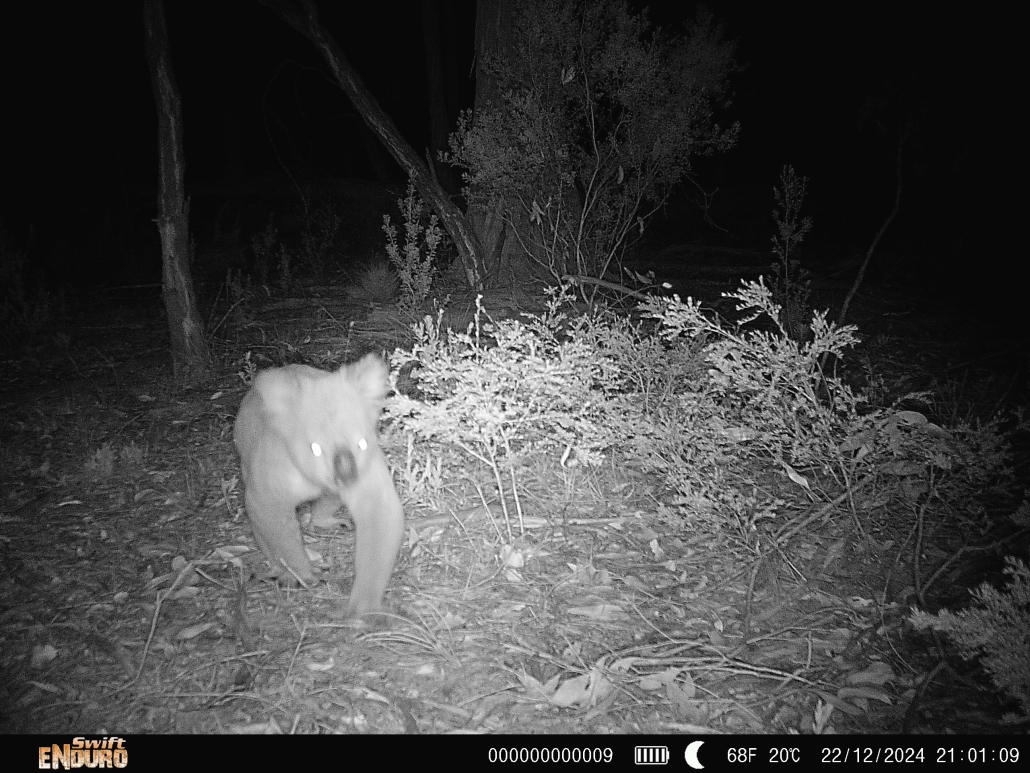
One of the first steps in the project was establishing baseline biodiversity monitoring. Wildlife cameras placed throughout the reserve offered a fascinating glimpse into the animals that call Ngurang home. The footage revealed a thriving woodland community, including lyrebirds, wombats, echidnas, lace monitors and possums. Among the highlights were confirmed sightings of koalas and the discovery of a small carnivorous marsupial, an antechinus, both encouraging signs for the health of the ecosystem.
The monitoring work was supported by a community wildlife camera workshop held in Kandos, where volunteers gathered to help review images and learn how to identify species captured on camera. The day was a powerful reminder that conservation is often a shared effort, built on many curious eyes and willing hands.
Alongside wildlife monitoring, vegetation surveys were conducted to better understand the plant communities present within the reserve. These surveys documented a rich diversity of woodland species, including the vulnerable Capertee Stringybark (Eucalyptus cannonii), a tree endemic to the Capertee Valley region. These baseline surveys will be repeated in the future to track how the vegetation responds following cultural burning.
A central focus of the project was the reintroduction of cultural fire.
A wonderful group of people gathered around this project, attending events along the way and volunteering their time to help prepare for the cultural burns. Preparation work included reducing excess fuel loads to ensure the fire would remain cool and controlled, raking around trees to prevent canopy fires, and temporarily moving habitat logs out of the burn path. Several mornings were spent together on Country getting the site ready, sharing knowledge and learning more about the landscape along the way.
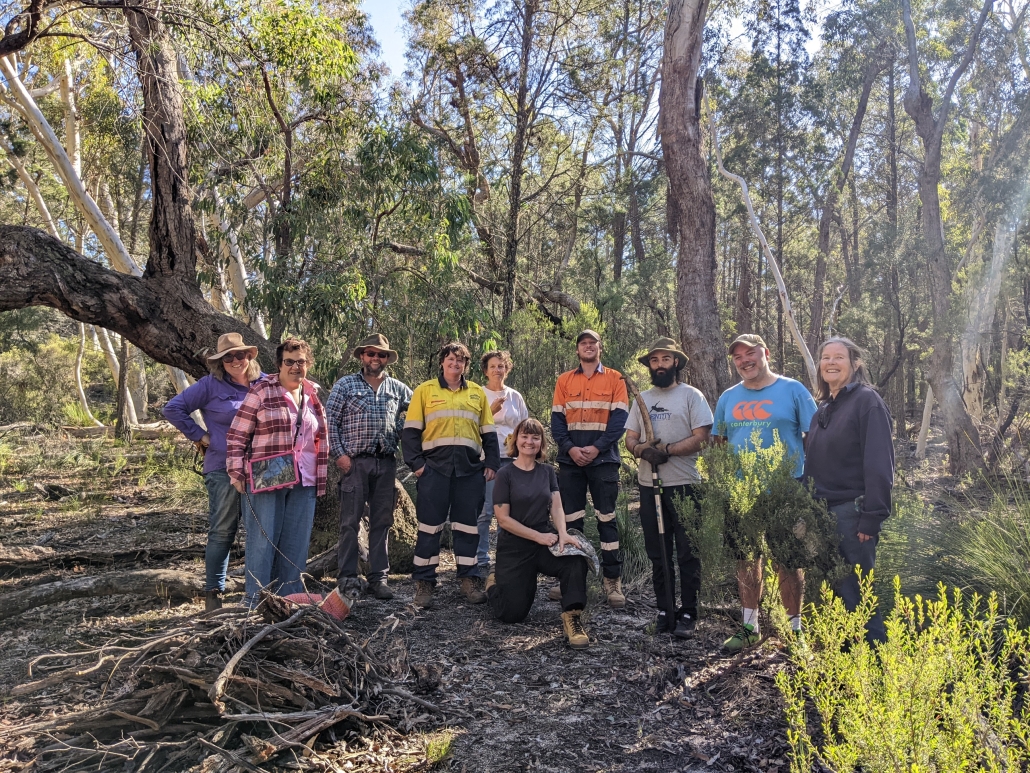
In June 2025, two carefully planned cultural burns were carried out at Ngurang Reserve, led by Emma Syme and the NEWco team. Around 15–20 Landcare volunteers and community members joined the burns alongside the NEWco crew, many of whom had participated in earlier project activities.
Extensive preparation had taken place in the weeks beforehand. Working bees helped remove excess woody debris and temporarily relocate habitat logs to keep the fire cool and controlled. Individual trees were protected with small firebreaks, preventing canopy fires and helping maintain the integrity of the woodland.
When the burns were finally lit, the fires moved slowly and gently through the grasses and built-up leaf litter. A soft white smoke drifted quietly through the trees as participants worked together to guide the flames across selected patches of ground. The mosaic pattern of the burn created a patchwork of treated and untreated areas—an approach that supports biodiversity by leaving refuge for insects, reptiles and small mammals while reducing fuel loads.
For many participants, it was their first opportunity to witness cultural fire practice firsthand. Under the guidance of the NEWco team, community members were even able to light and manage small sections of the burn themselves, gaining a deeper appreciation for the skill, patience and observation required to work with fire in this way.
The final event of the project brought the community back to Ngurang Reserve in September for a Songline Walk led by Uncle Peter Swain. The event quickly filled, with 25 participants joining the walk through the reserve.
Rather than following a formal presentation, the walk unfolded as a wide-ranging conversation guided by the landscape itself. As the group moved through the woodland, Uncle Peter shared stories about scar trees, native plants, rock shelters and the cultural significance of the land, responding to questions and observations from participants along the way.
One message that resonated strongly throughout the day was the idea that connection to Country is something everyone can cultivate.
No matter where someone comes from, Uncle Peter reflected, it is important to acknowledge the ancestors who came before us and the paths that brought us to where we are today. In that sense, everyone who lives here now becomes part of the story of this place. We are all connected to the songline of this landscape, and with that connection comes a shared responsibility to care for it.
Connection by Fire has been a powerful example of what can happen when cultural knowledge, community involvement and ecological science come together on Country. From wildlife discoveries and vegetation surveys to the careful use of cultural fire, the project has deepened understanding of Ngurang Reserve while strengthening relationships between people and place.
While the burns themselves were only recently completed, the learning from this project will continue. Future vegetation surveys will revisit the burn areas to observe how the woodland responds over time, helping build a longer-term picture of how cultural fire shapes biodiversity in the landscape.
Perhaps most importantly, the project has created new opportunities for people to engage with Country, listen to knowledge holders, and participate in caring for the land together.
The story of Ngurang Reserve is still unfolding, but through Connection by Fire, a strong foundation has been laid for ongoing collaboration, learning and stewardship of this remarkable place.
Thank you to our many collaborators and partners who helped support this project:
NEWco team, John Marshall- Central West Wildlife Carers Network, Cudgegong Rural Fire Service, Annabelle Murray who did the vegetation surveys, Central Tablelands Local Land Services, Uncle Peter Swain, Meg Williams, Gus Armstrong (Videographer), Candace Stott, Kellie Leigh Science for Wildlife
To all the volunteers and participants! Mundang Guwu (Thank you in Wiradjuri)

 https://watershedlandcare.com.au/wp-content/uploads/2019/03/planning_session_small.jpg
936
1846
wslc
http://watershedlandcare.com.au/wp-content/uploads/2016/12/logo-watershed-300x104.png
wslc2019-02-15 08:11:202019-03-01 08:14:35Planning for a resilient and sustainable environment for our future
https://watershedlandcare.com.au/wp-content/uploads/2019/03/planning_session_small.jpg
936
1846
wslc
http://watershedlandcare.com.au/wp-content/uploads/2016/12/logo-watershed-300x104.png
wslc2019-02-15 08:11:202019-03-01 08:14:35Planning for a resilient and sustainable environment for our future https://watershedlandcare.com.au/wp-content/uploads/2019/03/Superb-Parrot_small.jpg
1310
1964
wslc
http://watershedlandcare.com.au/wp-content/uploads/2016/12/logo-watershed-300x104.png
wslc2019-02-08 08:14:542019-03-01 08:17:57Imagine it took more than a 100 years to build your home?
https://watershedlandcare.com.au/wp-content/uploads/2019/03/Superb-Parrot_small.jpg
1310
1964
wslc
http://watershedlandcare.com.au/wp-content/uploads/2016/12/logo-watershed-300x104.png
wslc2019-02-08 08:14:542019-03-01 08:17:57Imagine it took more than a 100 years to build your home? https://watershedlandcare.com.au/wp-content/uploads/2019/02/box_gum.jpg
677
1200
wslc
http://watershedlandcare.com.au/wp-content/uploads/2016/12/logo-watershed-300x104.png
wslc2019-02-01 10:24:512019-02-06 10:26:01Important environmental factors about our Box Gum Woodlands
https://watershedlandcare.com.au/wp-content/uploads/2019/02/box_gum.jpg
677
1200
wslc
http://watershedlandcare.com.au/wp-content/uploads/2016/12/logo-watershed-300x104.png
wslc2019-02-01 10:24:512019-02-06 10:26:01Important environmental factors about our Box Gum Woodlands http://watershedlandcare.com.au/wp-content/uploads/2016/12/logo-watershed-300x104.png
0
0
wslc
http://watershedlandcare.com.au/wp-content/uploads/2016/12/logo-watershed-300x104.png
wslc2019-01-04 11:15:182019-01-08 11:17:09Helping your garden deal with the heat wave
http://watershedlandcare.com.au/wp-content/uploads/2016/12/logo-watershed-300x104.png
0
0
wslc
http://watershedlandcare.com.au/wp-content/uploads/2016/12/logo-watershed-300x104.png
wslc2018-12-21 10:53:002019-01-08 11:06:59Microbes deep within
https://watershedlandcare.com.au/wp-content/uploads/2019/01/echidna.jpg
410
729
wslc
http://watershedlandcare.com.au/wp-content/uploads/2016/12/logo-watershed-300x104.png
wslc2018-12-14 10:59:482019-01-08 11:07:56Spiky citizen science
http://watershedlandcare.com.au/wp-content/uploads/2016/12/logo-watershed-300x104.png
0
0
wslc
http://watershedlandcare.com.au/wp-content/uploads/2016/12/logo-watershed-300x104.png
wslc2018-12-07 11:10:202019-01-08 11:13:20Filling the gaps in pest control
http://watershedlandcare.com.au/wp-content/uploads/2016/12/logo-watershed-300x104.png
0
0
wslc
http://watershedlandcare.com.au/wp-content/uploads/2016/12/logo-watershed-300x104.png
wslc2018-11-30 13:30:052018-12-06 13:31:27Watershed Landcare AGM
http://watershedlandcare.com.au/wp-content/uploads/2016/12/logo-watershed-300x104.png
0
0
wslc
http://watershedlandcare.com.au/wp-content/uploads/2016/12/logo-watershed-300x104.png
wslc2018-11-23 13:25:372018-12-06 13:27:28Recognising and increasing the value of roadside corridors
http://watershedlandcare.com.au/wp-content/uploads/2016/12/logo-watershed-300x104.png
0
0
wslc
http://watershedlandcare.com.au/wp-content/uploads/2016/12/logo-watershed-300x104.png
wslc2019-01-04 11:15:182019-01-08 11:17:09Helping your garden deal with the heat wave
http://watershedlandcare.com.au/wp-content/uploads/2016/12/logo-watershed-300x104.png
0
0
wslc
http://watershedlandcare.com.au/wp-content/uploads/2016/12/logo-watershed-300x104.png
wslc2018-12-21 10:53:002019-01-08 11:06:59Microbes deep within
https://watershedlandcare.com.au/wp-content/uploads/2019/01/echidna.jpg
410
729
wslc
http://watershedlandcare.com.au/wp-content/uploads/2016/12/logo-watershed-300x104.png
wslc2018-12-14 10:59:482019-01-08 11:07:56Spiky citizen science
http://watershedlandcare.com.au/wp-content/uploads/2016/12/logo-watershed-300x104.png
0
0
wslc
http://watershedlandcare.com.au/wp-content/uploads/2016/12/logo-watershed-300x104.png
wslc2018-12-07 11:10:202019-01-08 11:13:20Filling the gaps in pest control
http://watershedlandcare.com.au/wp-content/uploads/2016/12/logo-watershed-300x104.png
0
0
wslc
http://watershedlandcare.com.au/wp-content/uploads/2016/12/logo-watershed-300x104.png
wslc2018-11-30 13:30:052018-12-06 13:31:27Watershed Landcare AGM
http://watershedlandcare.com.au/wp-content/uploads/2016/12/logo-watershed-300x104.png
0
0
wslc
http://watershedlandcare.com.au/wp-content/uploads/2016/12/logo-watershed-300x104.png
wslc2018-11-23 13:25:372018-12-06 13:27:28Recognising and increasing the value of roadside corridors
