

A New Chapter for Watershed’s Communities of Practice
Published 4th May 2025. Written by Maddison O’Brien
A New Chapter for Watershed’s Communities of Practice: Introducing the Roots to Resilience Network
Watershed Landcare is excited to announce an evolution in its much-loved Communities of Practice, with the Grazing Group and Microscope Group coming together under a new shared banner: the Roots to Resilience Network.
This exciting next step builds on years of learning, connection and practical action across both groups. The Mudgee Microscope Group first emerged from a soil health workshop in 2014, growing into a curious and creative community of locals passionate about taking a closer look at the biological life beneath our feet and across the landscape. Meanwhile, the Grazing Group has long provided a valued space for graziers to gather around paddock walks, seasonal challenges, pasture management and peer-to-peer support.
Over the past 18 months, it has become increasingly clear that the two groups share not only many of the same members, but also deeply aligned goals around soil health, landscape resilience, grazing outcomes and adaptive land management.
When the opportunity arose to secure support through the Landcare NSW Enabling Program, it felt like the perfect time to respond to that community feedback and bring the two streams together.
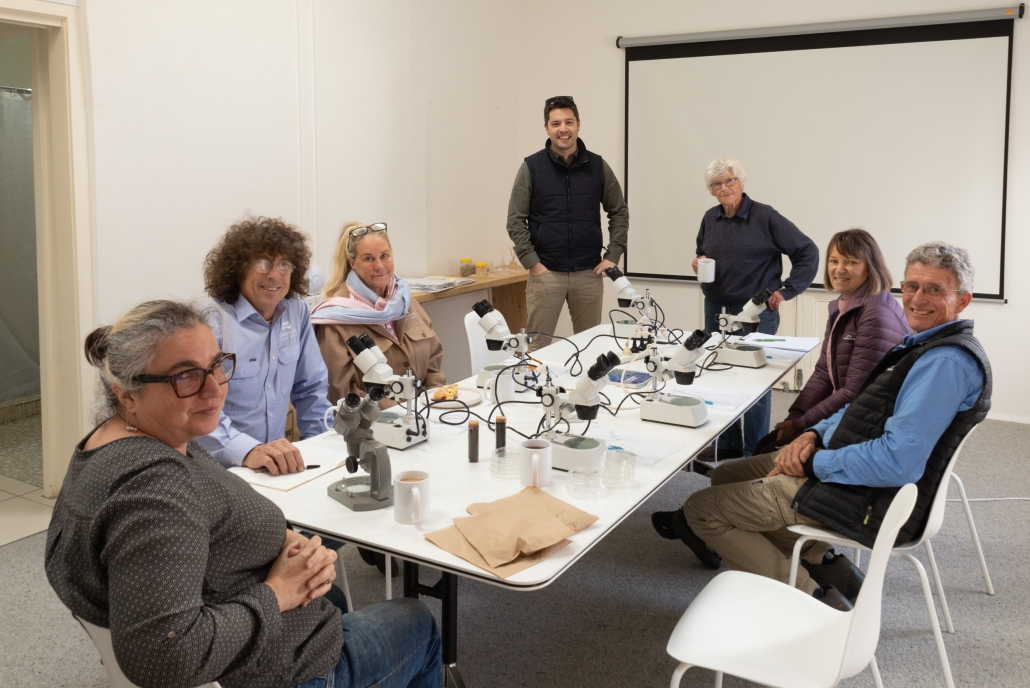
The Microscope Group in 2023 learning about microscopic soil life and the soil food web.
Rather than splitting energy across two groups with similar focus areas, this new model allows Watershed Landcare to deliver a richer, more in-depth and better-resourced 12-month program of workshops, field days and hands-on learning experiences.
While change can sometimes bring mixed feelings, this merger is very much about carrying forward the best of both groups. Microscope Group members can rest assured that there will still be plenty of opportunities to whip out the microscopes, dig into soil biology, and explore the science beneath healthy landscapes. Likewise, graziers can look forward to dedicated sessions focused on grazing strategy, pasture function, seasonal decision-making and farm resilience.
Bruce Christie, Chairperson of Watershed Landcare said the new network is all about building on the strong foundations already laid.
“Both groups have built something really special over the years. This new chapter gives us the chance to honour that history while creating even more opportunities for practical learning, deeper conversations and stronger community connections.”
Across the next 12 months, members can look forward to workshops and field days exploring topics such as soil health, grazing management, pasture function, resilience planning, seasonal decision-making and landscape monitoring, with opportunities to register expressions of interest for guest speakers or suggest people they would love to hear from within these themes.
The Roots to Resilience Network will officially kick off in late April 2026, with dates and program details to be announced soon.
If you would like more information contact info@watershedlandcare.com.au

 https://watershedlandcare.com.au/wp-content/uploads/2020/05/dam_small.jpg
901
1200
wslc
http://watershedlandcare.com.au/wp-content/uploads/2016/12/logo-watershed-300x104.png
wslc2020-04-03 11:52:192020-05-13 11:55:33Do you know your harvestable rights?
https://watershedlandcare.com.au/wp-content/uploads/2020/05/dam_small.jpg
901
1200
wslc
http://watershedlandcare.com.au/wp-content/uploads/2016/12/logo-watershed-300x104.png
wslc2020-04-03 11:52:192020-05-13 11:55:33Do you know your harvestable rights? https://watershedlandcare.com.au/wp-content/uploads/2020/04/creek1_small.jpg
678
1034
wslc
http://watershedlandcare.com.au/wp-content/uploads/2016/12/logo-watershed-300x104.png
wslc2020-03-27 10:50:182020-04-01 10:54:05Do you have a creek or river on your land?
https://watershedlandcare.com.au/wp-content/uploads/2020/04/creek1_small.jpg
678
1034
wslc
http://watershedlandcare.com.au/wp-content/uploads/2016/12/logo-watershed-300x104.png
wslc2020-03-27 10:50:182020-04-01 10:54:05Do you have a creek or river on your land? http://watershedlandcare.com.au/wp-content/uploads/2016/12/logo-watershed-300x104.png
0
0
wslc
http://watershedlandcare.com.au/wp-content/uploads/2016/12/logo-watershed-300x104.png
wslc2020-03-24 10:18:352020-03-24 10:19:53Organisms at the edge of life
http://watershedlandcare.com.au/wp-content/uploads/2016/12/logo-watershed-300x104.png
0
0
wslc
http://watershedlandcare.com.au/wp-content/uploads/2016/12/logo-watershed-300x104.png
wslc2020-03-24 10:18:352020-03-24 10:19:53Organisms at the edge of life https://watershedlandcare.com.au/wp-content/uploads/2020/03/women_in_ag_tamara_garden_small.jpg
900
1200
wslc
http://watershedlandcare.com.au/wp-content/uploads/2016/12/logo-watershed-300x104.png
wslc2020-03-13 11:19:472020-03-18 11:22:39Building capacity in rural women
https://watershedlandcare.com.au/wp-content/uploads/2020/03/women_in_ag_tamara_garden_small.jpg
900
1200
wslc
http://watershedlandcare.com.au/wp-content/uploads/2016/12/logo-watershed-300x104.png
wslc2020-03-13 11:19:472020-03-18 11:22:39Building capacity in rural women https://watershedlandcare.com.au/wp-content/uploads/2020/03/soil_worm.jpg
675
1200
wslc
http://watershedlandcare.com.au/wp-content/uploads/2016/12/logo-watershed-300x104.png
wslc2020-03-06 11:23:032020-03-18 11:25:42So why is soil pH important?
https://watershedlandcare.com.au/wp-content/uploads/2020/03/soil_worm.jpg
675
1200
wslc
http://watershedlandcare.com.au/wp-content/uploads/2016/12/logo-watershed-300x104.png
wslc2020-03-06 11:23:032020-03-18 11:25:42So why is soil pH important? https://watershedlandcare.com.au/wp-content/uploads/2020/03/stuart_andrews.jpg
562
1000
wslc
http://watershedlandcare.com.au/wp-content/uploads/2016/12/logo-watershed-300x104.png
wslc2020-02-28 12:57:592020-03-02 13:01:38Growing interest in restoring the natural cycling of water
https://watershedlandcare.com.au/wp-content/uploads/2020/03/stuart_andrews.jpg
562
1000
wslc
http://watershedlandcare.com.au/wp-content/uploads/2016/12/logo-watershed-300x104.png
wslc2020-02-28 12:57:592020-03-02 13:01:38Growing interest in restoring the natural cycling of water https://watershedlandcare.com.au/wp-content/uploads/2020/03/colin_seis_small.jpg
2336
3504
wslc
http://watershedlandcare.com.au/wp-content/uploads/2016/12/logo-watershed-300x104.png
wslc2020-02-21 13:02:222020-03-02 13:10:39Local landholder to trial multi-species crop to improve livestock performance through winter
https://watershedlandcare.com.au/wp-content/uploads/2020/03/colin_seis_small.jpg
2336
3504
wslc
http://watershedlandcare.com.au/wp-content/uploads/2016/12/logo-watershed-300x104.png
wslc2020-02-21 13:02:222020-03-02 13:10:39Local landholder to trial multi-species crop to improve livestock performance through winter https://watershedlandcare.com.au/wp-content/uploads/2020/03/box_gum_grassy_woodland_small.jpg
2304
3072
wslc
http://watershedlandcare.com.au/wp-content/uploads/2016/12/logo-watershed-300x104.png
wslc2020-02-14 13:13:442020-03-02 13:16:13Landholder incentives to enhance Box Gum Grassy Woodlands
https://watershedlandcare.com.au/wp-content/uploads/2020/03/CK_resprouterfern_small.jpg
3072
4096
wslc
http://watershedlandcare.com.au/wp-content/uploads/2016/12/logo-watershed-300x104.png
wslc2020-02-07 11:52:572020-03-02 13:02:19Help contribute to bushfire recovery science
https://watershedlandcare.com.au/wp-content/uploads/2020/03/box_gum_grassy_woodland_small.jpg
2304
3072
wslc
http://watershedlandcare.com.au/wp-content/uploads/2016/12/logo-watershed-300x104.png
wslc2020-02-14 13:13:442020-03-02 13:16:13Landholder incentives to enhance Box Gum Grassy Woodlands
https://watershedlandcare.com.au/wp-content/uploads/2020/03/CK_resprouterfern_small.jpg
3072
4096
wslc
http://watershedlandcare.com.au/wp-content/uploads/2016/12/logo-watershed-300x104.png
wslc2020-02-07 11:52:572020-03-02 13:02:19Help contribute to bushfire recovery science
